



Skip to content
Prep Britain
Checking warnings…

A storm is coming: get the house ready the day before

Storms usually come with a day or two's warning from the Met Office, so there's time to get ready. Most of what helps happens before the wind arrives: tie down what could blow, charge what you'd need in a power cut, and decide now not to travel. This page covers the warning colours, the day before, the storm itself and the morning after.

Reviewed 9 Oct 2026 9 min read Free to read

Do these three first · 30 minutes

Check the warning colour

Yellow means some disruption. Amber means think about changing your plans. Red means act now.

Tie down the garden

Bins, trampolines, garden chairs, ladders and toys. Anything that could go through a window.

Charge everything

Phones, power banks and any backup batteries for medical equipment. Storms often cut the power.

Power off? Call 105 Free, and it reaches your local network operator. Call it too for power lines brought down by the wind, and keep well away from them. In Northern Ireland, call NIE Networks on 03457 643 643. In trouble at the coast? Call 999 and ask for the Coastguard.

Bins strapped, chairs stacked, curtains drawn. The work is done before the wind arrives.

This winter: the El Niño outlook. The strongest El Niño on record raises the chance of "wetter and stormier conditions across north-west Europe, including the UK, during autumn and early winter". From October to December, the government's briefing expects "a slightly increased chance" of the westerly winds and low pressure "associated with increased storminess". On 5 October the Met Office added that these "are shifts in probability rather than guarantees", and that El Niño "does not determine individual weather events". So the warning for your area matters more than the season's headlines: see what's in force. The first storm named this season will be Austen. El Niño and the UK winter has the forecasts and a month-by-month plan.

Yellow, amber or red?

The Met Office picks the colour from two things: how much damage the weather could do, and how likely that is. Read the warning's own text for what to expect where you live.

Yellow

Some impacts are likely, such as delays to travel. Check the forecast again before you go out, and get the garden tied down.

Amber

Severe weather could well disrupt your plans. Think about changing them, and act to protect yourself and your home.

Red

Dangerous weather is expected, with a very likely risk to life. If you haven't already acted to keep everyone safe, do it now.

The Met Office Weather app can send you alerts for your own area.

Six steps, from the day before to the morning after

Steps one to four are for the day before, or as soon as a warning is issued. Five is the storm itself, and six the morning after.

Tie down anything that could blow

The day before

Walk round the garden and ask of each thing: could the wind put this through a window? Secure ladders, trampolines, garden furniture, toys and play equipment. Strap wheelie bins to a post or railing, or bring them in.

  • Close and fasten doors and windows, starting with the side facing the wind and any garage doors.
  • Bolt the loft hatch shut, especially if your roof is shallow.
  • If a tall chimney is in poor condition, move beds away from the rooms beneath it.
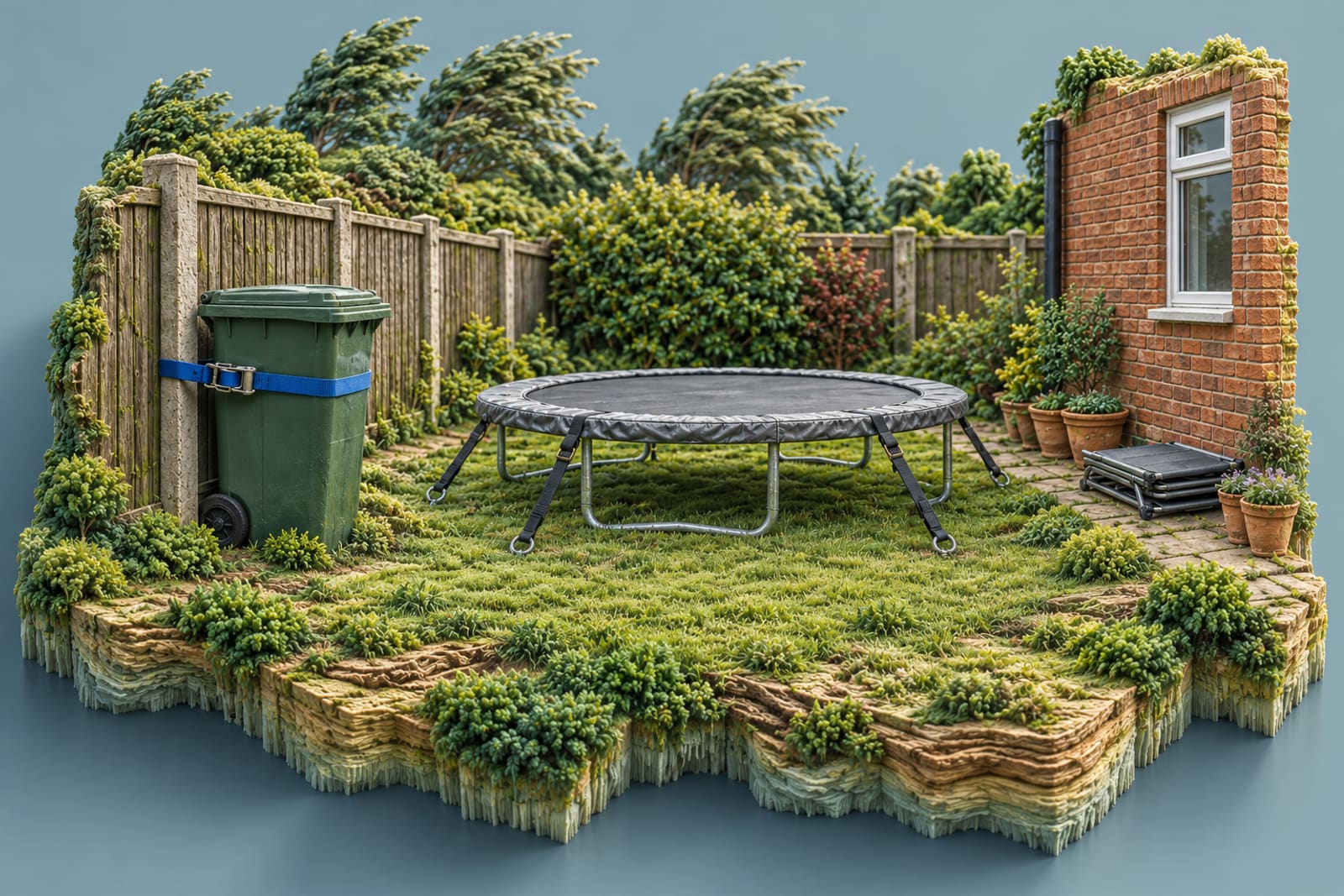
A back garden on a windy day: a green wheelie bin ratchet-strapped to a fence post, a trampoline held down with straps pegged into the lawn, folded chairs laid flat on the patio and plant pots moved against the house wall
Bin strapped to a post, trampoline pegged down, chairs laid flat. Anything left loose can go through a window.

Get ready for a power cut

The day before

Storms bring down power and phone lines. Charge phones, power banks and any backup batteries for medical equipment, and find out who your power network operator is. Put torches where you'd find them in the dark.

If it goes off

Our power cut guide takes you through the first hour, in order.

Water on a pump?

Upper-floor flats and homes on a private pump can lose water too. Our no-water guide covers it.

Move the car and change your plans

The day before

Park in a garage if you have one. If not, park clear of buildings, trees, walls and fences. Put off any journey you can, and follow any Do Not Travel notice.

If you have to drive, keep both hands on the wheel for gusts, leave at least four seconds behind the car in front, and give cyclists, motorcyclists and people walking more room than usual. Avoid exposed bridges and high open roads.

Check on the people nearby

Before it arrives

A storm is hardest on anyone alone, older, or relying on mains-powered equipment, especially if it brings a long power cut. Knock on two doors before the weather turns. Offer to bring their bins in while you're doing yours.

Stay in, and stay away from walls and trees

During the storm

Stay indoors as much as you can. If you have to go out, don't walk or shelter near buildings, trees, fences or boundary walls. Use the door on the side away from the wind, and close it behind you.

  • Keep away from the sheltered side of a wall or fence. If it falls, that is the side it falls onto.
  • Don't go out to fix damage while the storm is still blowing. It will still be there tomorrow.

Power lines down? Keep well away, and keep others back. High-voltage electricity can jump gaps with no warning. Call 105, or 999 if anyone is in danger.

Check for damage, carefully

The day after

Walls, trees and buildings can be weakened even if they're still standing, so don't walk close to them. Don't touch any power or phone cables that have come down or are still hanging.

  • Photograph any damage before you clear it, for the insurance claim.
  • Check that neighbours and relatives are safe, and help them arrange repairs.
  • Heavy rain can keep rivers rising for days afterwards. Keep an eye on flood warnings.

Flooded street or a flood warning? Our flooding guide picks up from here.

Watch the waves from a window

Storm waves and crumbling cliffs catch people out every winter. HM Coastguard's advice is short.

Feel the spray?

Then you're too close. One wave is all it takes to drag someone out to sea, and no photo is worth it.

Stay off the cliffs

Cliffs crumble in heavy rain. Keep clear of both the edge and the bottom, during and after the rain.

Someone in trouble?

Call 999 and ask for the Coastguard, whether it's you or someone you can see.

Three things worth having before the season

For most homes, the worst a storm brings is a long power cut. These keep you lit, charged and in touch until the power's back.

  • Lantern

    A battery lantern for the room you stay in

    Lights a whole room without a flame. The safe replacement for candles.

    • LED, battery-powered, and able to stand or hang
    • A dim setting that lasts all evening
    • Takes the same batteries as your torches
  • Power bank

    A 20,000 mAh power bank

    Keeps phones charged for a couple of days, so you can call 105, check the live map and reach family.

    • 20,000 mAh or more, with a USB-C port
    • Shows how much charge is left
    • Top it up every few months so it is full when you need it
  • Radio

    A wind-up or battery radio

    Local radio carries updates when the mobile network is busy or down.

    • Wind-up or solar charging, as well as batteries
    • FM and DAB
    • A built-in torch is a useful extra

The day before a storm, on one page

Nine lines, in order. Print it when the first yellow warning of the autumn goes out, and keep it on the fridge.

Storm · the day before

Download PDF

If it's something else

See every situation guide

Get the monthly brief: one job before each season turns

One email a month: new guides as they're published, and one job to do before the season turns, from lagging the pipes in autumn to checking the torch batteries before the storms.

We'll only use your email to send the Prep Britain newsletter. Unsubscribe any time. How we handle it