



Skip to content
Prep Britain
Checking warnings…

Flooding near me? Read the warning, then get people and valuables up

Most floods come with some warning. There are three levels, and each one tells you how much time you have. This page takes you from the first alert to drying out afterwards: what to move, what to switch off, and what never to walk or drive through.

Reviewed 9 Oct 2026 11 min read Free to read

Do these three first · 5 minutes

Check which warning it is

A flood alert means get ready. A flood warning means act now. A severe flood warning means danger to life.

Move people, pets and medicines up

Upstairs, or to higher ground. Then documents and anything you can't replace.

Stay out of floodwater

Just 30cm of moving water can float a car. Turn around and find another way.

Floodline: 0345 988 1188 Warnings and advice, 24 hours a day, for England, Scotland and Wales. In Northern Ireland, report flooding on 0300 2000 100. If anyone is in immediate danger, call 999.

Water in the road is a reason to stay in rather than go and look.

This winter: the El Niño outlook. The Met Office puts the chance of a warm, wet autumn at "around one-and-a-half to two times higher than would normally be expected". The government's briefing on El Niño lists an "increased risk of heavy rainfall and flooding". In Scotland, SEPA asks people to sign up to Floodline for "the places that matter" to them as well as home. Sign up now, before the ground is soaked. The Met Office stresses that El Niño "does not determine individual weather events", so it's the flood warning for your area that tells you to act. See what's in force. El Niño and the UK winter has the forecasts and a month-by-month plan.

Read the warning: it tells you how long you have

The Environment Agency in England, SEPA in Scotland and Natural Resources Wales use the same three levels. They cover flooding from rivers, the sea and groundwater.

The three levels of flood warning, when each is usually issued, and what to do
WarningUsually issuedWhat it means and what to do
Flood alert 2–12 hours beforeFlooding is possible: prepare now. Get your flood plan out, gather medicines and insurance papers, and keep off flooded roads.
Flood warning 30 min–2 hours beforeFlooding is expected: act now. Move family, pets and valuables upstairs, turn off gas, electricity and water if it is safe, and put up flood protection.
Severe flood warning When life is at riskDanger to life: act now. Stay somewhere safe, be ready to leave, and do what the emergency services say. Call 999 if you are in immediate danger.

Wording and timings from the Environment Agency's guide to flood warnings. Warnings don't cover surface water from sudden heavy rain, so keep an eye on the Met Office's rain warnings too.

Get warnings for free

By phone, text or email, day or night. England via GOV.UK, Scotland via SEPA's Floodline, Wales via Natural Resources Wales.

Check your street's risk

Put your postcode into the long-term flood risk check. It covers rivers, the sea, surface water and reservoirs, though not your house in particular.

In Northern Ireland

Check the flood maps on nidirect, and report flooding on 0300 2000 100, one number for the whole of Northern Ireland.

Six steps to get your household above the water

Steps one to four are for a flood alert or warning, while there's still time. Five and six apply from the moment the water arrives.

Get people, pets and medicines up

0–15 min

Start with whoever will take longest: an older relative, small children, anyone who struggles with stairs. Then the pets. Then a grab bag: medicines, a first aid kit, important documents, a torch, bottled water, warm waterproof clothes and anything a baby needs.

  • Chargers and a power bank go up too. Floods often cut the power.
  • In a bungalow or ground-floor flat, decide now where you would go if you had to leave.
  • Tell a neighbour or relative what you are doing.
Move what you can't replace

Before the water

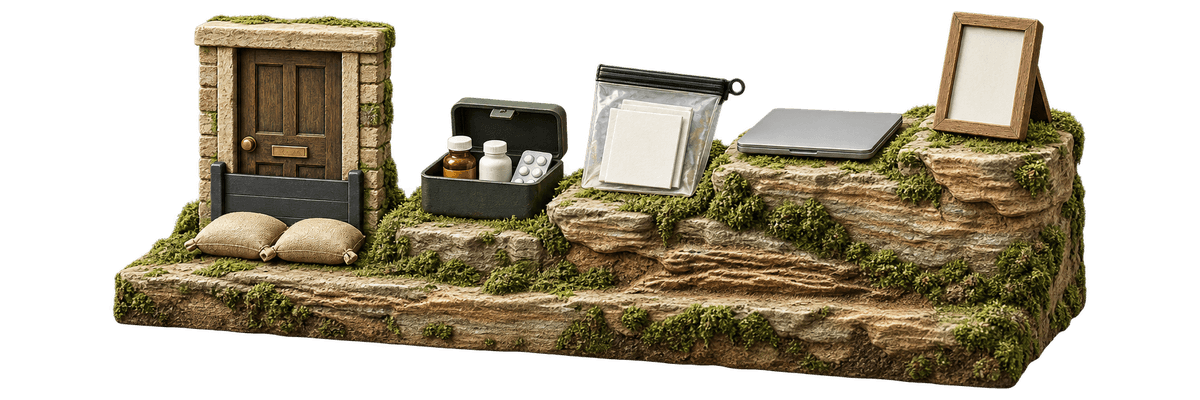
Put sentimental and valuable things upstairs, or on the top shelf of a cupboard. Seal documents such as birth certificates in watertight bags. Furniture can wait; photo albums can't.

A short flight of stairs with medicines, a document pouch, a laptop and a framed photo on the upper steps, and a front door with a flood board and two sandbags at the bottom
Up the stairs go the things you can't buy again. The flood board goes across the door.

Switch off gas, electricity and water

Before the water

Know where all three are before you need them: the water stop tap where the supply comes in, the gas valve by the meter, and the main switch on the fuse board. Our no-water guide shows where stop taps usually hide.

Only if it's safe. Turn them off if you can do it without going into water. Never touch an electrical switch while you are standing in water.

Put up flood protection

Before the water

If you have flood boards, door barriers or airbrick covers, fit them now. Sandbags or flood bags go where water would get in first: doorways, then low airbricks.

No barriers yet?

Don't go out to look for sandbags once water is in the street. Use what you have and get upstairs.

For next time

Flood bags store flat in a cupboard and swell with water in minutes. They're in the kit list below.

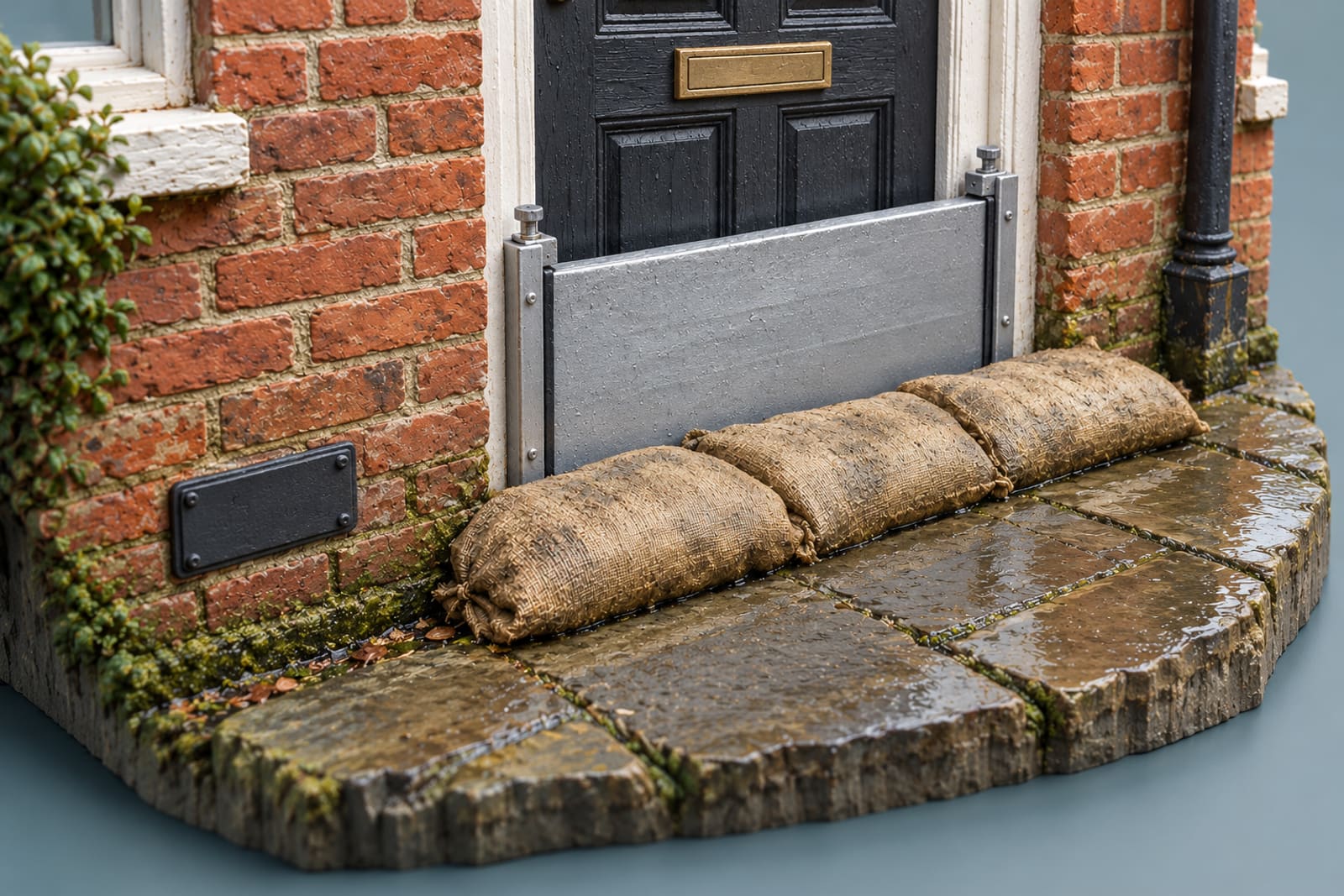
A metal flood board clamped across the bottom of a front door, three sandbags along its base on the wet path, and a cover fitted over the airbrick in the brick wall beside it
Board across the door, sandbags along the bottom, and the airbrick covered. Water finds the lowest gap first.

Stay out of the water

When water arrives

Floodwater looks harmless and isn't. It can carry sewage, and it hides rubbish, broken roads and missing drain and manhole covers. Don't walk through it, and don't let children play in it.

Never drive through floodwater. Just 30cm of moving water is enough to float a car, and driving through floodwater is the leading cause of death in floods. The Met Office puts it in four words: turn around, don't drown.

Go when you're told, and take the bag

If you're told to leave

If the council or the emergency services ask you to leave, go. Take the grab bag and your phone, lock up, and tell someone where you're heading.

  • Knock on two doors on the way. Check on anyone who can't carry things upstairs.
  • If you stay put, stay upstairs, and keep a phone charged and a torch with you.
  • Call 999 if anyone is in immediate danger.

Dry out slowly and safely

When the water goes down, go carefully. Leave the power off, and photograph everything before you clear anything.

Electricity and gas

  • Leave the power off at the fuse box, and don't use mains appliances that got wet.
  • Get a registered electrician to check the wiring, and ask for an Electrical Installation Condition Report (EICR).
  • Don't turn the gas or electricity back on until a professional says it's safe.

The insurance claim

  • Photograph or film all the damage before you clear anything.
  • Mark the highest water level on the walls before it dries.
  • Get your insurer to agree before any repair work starts.

Keep your hands clean

Wash your hands often while you clear up. It's the best way to remove the germs and chemicals floodwater leaves behind.

Insurance in a flood-risk area

Flood Re helps people in flood-risk areas find lower-cost home insurance. Some insurers also pay up to £10,000 towards flood protection as part of a repair claim.

An hour on a dry day

Most of this costs nothing, and all of it is easier now than with water at the door.

  • Sign up for free flood warnings, and check your long-term flood risk by postcode.
  • Find your water stop tap, gas valve and fuse board, and label them.
  • Pack a grab bag and keep it by the stairs.
  • Put documents in watertight bags now, so you only have to carry them up.
  • Check your home insurance covers flooding, and keep the policy number on your phone.
  • Ask your council whether there is a local flood action group or flood warden.

Three things worth having in the cupboard

None of them stop a serious flood. They buy time, keep the important papers dry, and keep you in touch if the power goes.

  • Flood bags

    Self-inflating flood bags

    They stay flat and light in a cupboard until you need them, then swell with water in a few minutes. Easier to store and carry than sand.

    • Swell on contact with water, no sand needed
    • Sold in packs of five or ten
    • Check how high they stack against your door
    Rough price£25–£50 for a pack Browse on Amazon : flood bags, opens in a new tab
  • Document pouch

    A waterproof document pouch

    Passports, insurance papers and birth certificates in one sealed bag you can grab on the way upstairs.

    • A seal that zips or rolls shut, not just a press-stud
    • Big enough for A4 papers unfolded
    • Tough enough to carry, not freezer-bag thin
  • Radio

    A wind-up or battery radio

    Local radio carries updates when the mobile network is busy or down.

    • Wind-up or solar charging, as well as batteries
    • FM and DAB
    • A built-in torch is a useful extra

When a flood warning comes, on one page

Nine lines, in order. Print it once and keep it by the stairs, with the grab bag.

Flooding · when the warning comes

Download PDF

If it's something else

See every situation guide

Get the monthly brief: one job before each season turns

One email a month: new guides as they're published, and one job to do before the season turns, from lagging the pipes in autumn to checking the torch batteries before the storms.

We'll only use your email to send the Prep Britain newsletter. Unsubscribe any time. How we handle it