





Skip to content
Prep Britain
Checking warnings…

Flats and renters: what changes in an emergency

A flat shares its stairs, its pumps and its fire plan with the rest of the building, and a rented home comes with a landlord who fixes the big things. This page covers what that changes in a power cut, a water outage or a fire, and who to call for each.

Reviewed 26 Oct 2026 7 min read Free to read

Do these three first · 15 minutes

Save the landlord's emergency number

And the out-of-hours repairs line, or the managing agent if there is one. On paper as well as the phone.

Find the stopcock and the fuse box

In a flat they are often in a hallway cupboard. If you can't find them, ask the landlord.

Ask about the building's fire plan

Whether to stay put or leave if there is a fire elsewhere in the block. The landlord or managing agent has to tell you.

Fire? Get out and call 999 Use the stairs rather than the lift. Power cut? Call 105, or NIE Networks on 03457 643 643 in Northern Ireland. Smell gas? Call 0800 111 999, or 0800 002 001 in Northern Ireland.

Know the stairs in the dark, the fire plan, and the landlord's emergency number. Most of the rest follows from those.

What's different in a flat or a rented home

The emergencies are the same as anywhere else. What changes is the building around you, and who fixes what.

What changes in an emergency when you live in a flat or rent your home
WhatIn a flat or rented homeWhat to do
Lifts and door entry Both need power. So do the stair and corridor lightsKeep a head torch by the front door, and know the way down by the stairs
Water Many blocks pump water up to the higher floorsStore some. If the power is back and the water isn't, tell the landlord or managing agent
Fire Your building has a plan: stay put, or leaveFind out which. If the fire is in your flat, get out and use the stairs
Repairs Heating, hot water, gas, electrics and the shared stairs are usually the landlord'sReport faults straight away, in writing, and keep a record

Our guides, for a flat or a rented home

Each guide covers the whole situation. Here is what changes for you in each one.

Six steps, from the stopcock to the stairs

Steps one to three take an evening and cover most emergencies. Four to six are for the next weekend.

Find the stopcock and the fuse box

Today

In a flat, both are often in a hallway cupboard, under the kitchen sink or by the front door. A burst pipe needs the stopcock in minutes. A power cut starts with a look at the fuse box.

  • Turn the stopcock off and on again once, so you know it moves.
  • Find the main switch on the fuse box, and which switch is which.
  • Can't find either? Ask the landlord or managing agent, and write the answer down.
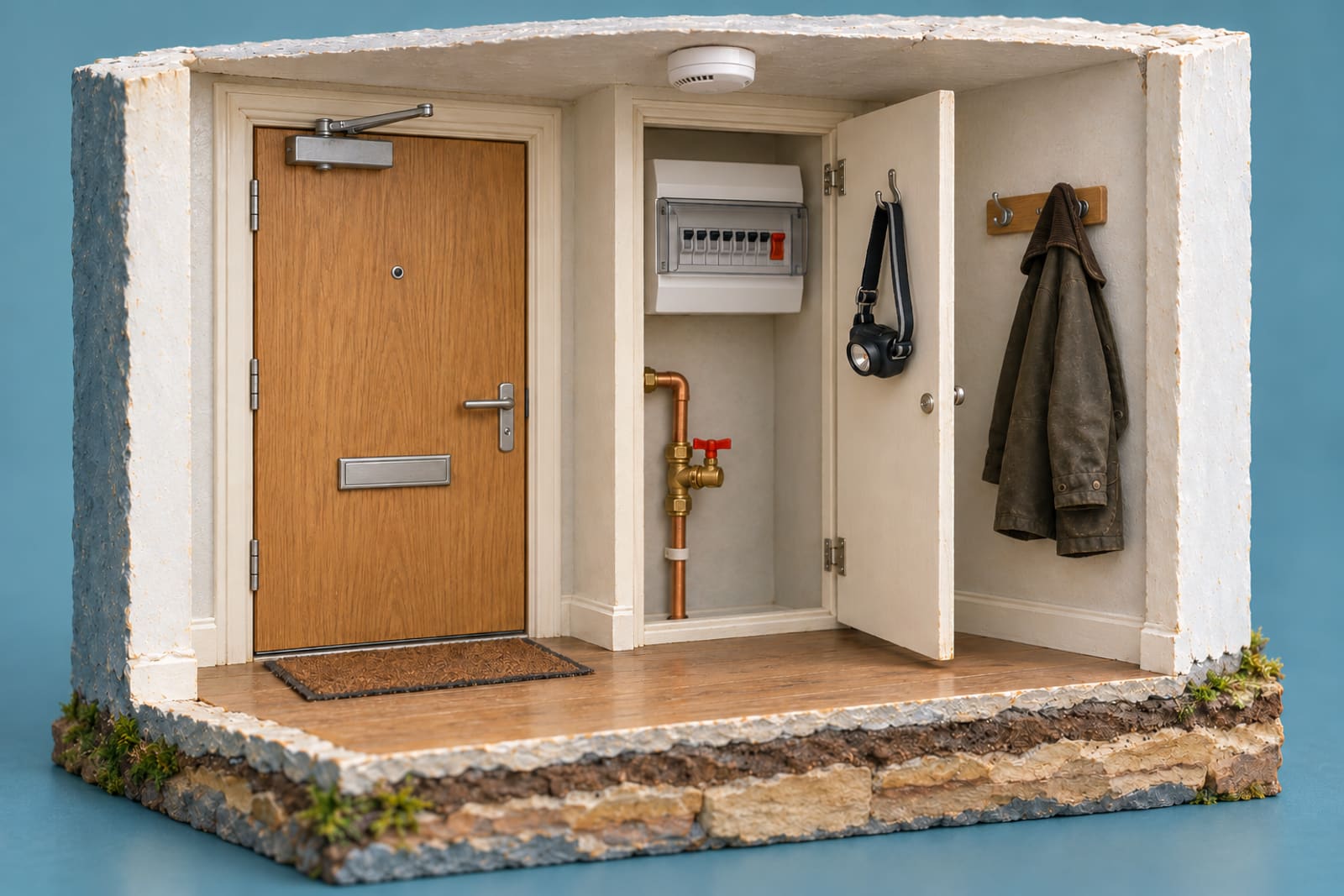
A flat's entrance hall: a wooden front door with an overhead door closer, a smoke alarm on the ceiling, and a hallway cupboard open to show a white consumer unit above a copper pipe with a brass stopcock, a head torch hanging inside the cupboard door, and a coat on a peg
The front door closes itself, the smoke alarm is on the ceiling, and the cupboard holds the fuse box and the stopcock. The head torch on the door is for the stairs in a power cut.

Learn your building's fire plan

This week

Your landlord, housing provider or managing agent needs to tell you about the fire safety arrangements for your building. The plan says whether to stay put or leave if a fire starts somewhere else in the block.

Fire in your flat

Alert everyone and leave. Use the stairs rather than the lift. Call 999 as soon as you are safe, and don't assume someone else has.

Told to stay put

Close your windows and doors and stay in your flat. Call 999 and tell them where you are in the building. Walls, floors and doors hold back flames and smoke for at least 30 to 60 minutes.

Keep the landings and stairs clear, and never prop open your front door or the fire doors in the corridor. Clutter can block the way out and feed a fire.

Save the numbers for repairs

This week

Your landlord is usually responsible for heating and hot water, gas appliances and pipes, the wiring, sinks, baths and drains, and shared areas such as the staircases in a block of flats. Contact them straight away about faults that could damage your health.

  • The landlord's or managing agent's number, and the out-of-hours repairs line.
  • Report by phone, email or the landlord's online system, then keep a note of what you reported and when.
  • Send photos or a short video if you can.
  • Keep paying the rent while you wait for a repair.

Put a head torch by the front door

Before winter

In a power cut, the lift stops and the stairwell can be dark. Walk the route down by the stairs once in daylight, so you know it. Keep a head torch on a hook by the door, so both hands are free for the rail.

Door entry

An entry phone or a fob door may stop working. Agree with visitors and carers how they will reach you.

Report the cut

Call 105 for the power. If only the shared lights are off, that's the landlord or managing agent.

Store some water

This month

Many blocks pump water up to the higher floors, so a power cut can stop the taps as well. A few bottles under the bed or in a cupboard cover drinking and washing until it comes back. How much water to store has the amounts.

Power back but still no water? The building's pumps may need restarting. Tell the landlord or managing agent.

Check the alarms and the insurance

This month

Press the test button on each smoke alarm, and on the carbon monoxide alarm if you have a gas boiler or fire. Then check your own insurance: the landlord's policy covers the building, and contents cover for your belongings is yours to arrange.

Alarm not working?

Replacing or repairing the alarms the landlord fitted is usually the landlord's job. Report it like any other repair.

Someone needs extra help?

If anyone in the flat is over state pension age, pregnant, has young children or uses medical equipment, join the Priority Services Register.

Who fixes what, in each nation

In all four nations, the heating, hot water, water, gas and electrics are the landlord's to keep working. How fast, and where you go if it isn't done, differs.

Landlord repair duties and what to do if repairs aren't done, in England, Wales, Scotland and Northern Ireland
NationThe landlord keeps workingIf it isn't fixed
England Heating and hot water, gas appliances, pipes and flues, the wiring, sinks, baths and drains, and shared areas such as the stairsContact your council's environmental health team
Wales The supply of water, gas and electricity, sanitation, heating and hot water, repaired in a reasonable timeTell the landlord first. Citizens Advice, Shelter Cymru or your council can contact them for you
Scotland Water, gas, electricity, sanitation and heating, plus interlinked smoke alarms, a heat alarm in the kitchen and a carbon monoxide alarm by any fuel-burning boiler or heaterThe First-tier Tribunal for Scotland (Housing and Property Chamber)
Northern Ireland Gas and electrical appliances always. Unless your terms say otherwise, the water, gas, electricity and heating, alarms, and lit, safe shared areasAdvice NI, Housing Rights or the Law Centre (NI)
Social housing in England. Under Awaab's Law, emergency repairs must be done within 24 hours. That covers gas or carbon monoxide leaks, broken boilers, no water supply at all, dangerous electrical problems and major leaks. If your landlord can't make the home safe in that time, they must offer you somewhere else to stay.

Three things that suit a flat

A torch for the stairs, a way to keep the phone charged, and water that fits in a cupboard.

  • Head torch

    A head torch for each adult

    Leaves both hands free for stairs, the consumer unit and the kettle. One per person beats one lamp per house.

    • Runs on AA or AAA batteries, so it works when USB chargers are flat
    • A red-light mode that keeps night vision
    • At least 200 lumens
  • Power bank

    A 20,000 mAh power bank

    Keeps phones charged for a couple of days, so you can call 105, check the live map and reach family.

    • 20,000 mAh or more, with a USB-C port
    • Shows how much charge is left
    • Top it up every few months so it is full when you need it
  • Water container

    A 10-litre water container with a tap

    For water you collect from a bowser in a long outage. It stands on the worktop and pours without lifting. For storing water ahead of time, buy sealed bottles instead.

    • Food-grade plastic, marked BPA-free
    • A screw-on tap, so it can stand on a worktop
    • 10 litres or less, so it can be carried full

Flats and renters, on one page

Nine lines, plus space for the numbers you'll need. Fill it in and keep it inside a kitchen cupboard door.

Flats and renters · this month

Download PDF

Other households

See every situation guide

Get the monthly brief: one job before each season turns

One email a month: new guides as they're published, and one job to do before the season turns, from lagging the pipes in autumn to checking the torch batteries before the storms.

We'll only use your email to send the Prep Britain newsletter. Unsubscribe any time. How we handle it