




Skip to content
Prep Britain
Checking warnings…

Families with young children: what changes in an emergency

With a baby or small children, a power cut or a water outage is mostly about feeds, sleep and keeping one room warm. This page covers safe bottles without a kettle and the right temperature for a baby's room. It also covers the free register that puts you first in an outage, and a plan the children can follow.

Reviewed 26 Oct 2026 7 min read Free to read

Do these three first · 15 minutes

Put ready-to-feed formula in the cupboard

If you bottle-feed, a few cartons cover feeds when you can't boil water. It needs no kettle and no mixing.

Join the Priority Services Register

It is free if you are pregnant or have young children. Sign up once through your electricity network operator.

Put a torch by each child's bed

A power cut at bedtime is mostly a lighting problem. Candles and small children don't mix.

Worried about a child? Call 111 For an emergency, call 999. Power cut? Call 105, or NIE Networks on 03457 643 643 in Northern Ireland.

Feeds, sleep and one warm room. Get those three right and a power cut at home with small children is a long evening rather than an emergency.

What's different with a baby or young children

Babies and children under 5 are among those most at risk from the cold, and from food poisoning. They also can't wait out a long evening the way adults can.

What changes in an emergency with a baby or young children
WhatWhy it mattersWhat to do
Bottle feeds Powdered formula is made up with water boiled and cooled to at least 70°CKeep ready-to-feed formula for when you can't boil water
Sterilising Boiling bottles needs a hobCold-water sterilising needs no power: at least 30 minutes, fresh solution every 24 hours
Sleep A baby's room should be about 16–20°CUse a room thermometer. No hot water bottle or electric blanket for a baby
Help in an outage Families with young children can join the Priority Services RegisterSign up once, through your electricity network operator

Our guides, for a family with young children

Each guide covers the whole situation. Here is what changes for you in each one.

Six steps, from the feeds to the school run

Steps one to three cover a power cut or a water outage tonight. Four to six are the plans to make this month.

Sort feeds that don't need a kettle

Today

Powdered formula isn't sterile. Make it up with freshly boiled water left to cool for no more than 30 minutes, so it stays at least 70°C. Ready-to-feed liquid formula needs no water at all. Once opened, it has to be used more quickly.

  • Keep a few cartons of ready-to-feed formula, and check the dates.
  • Throw away any formula left in the bottle after a feed.
  • Never add extra water to make formula go further.
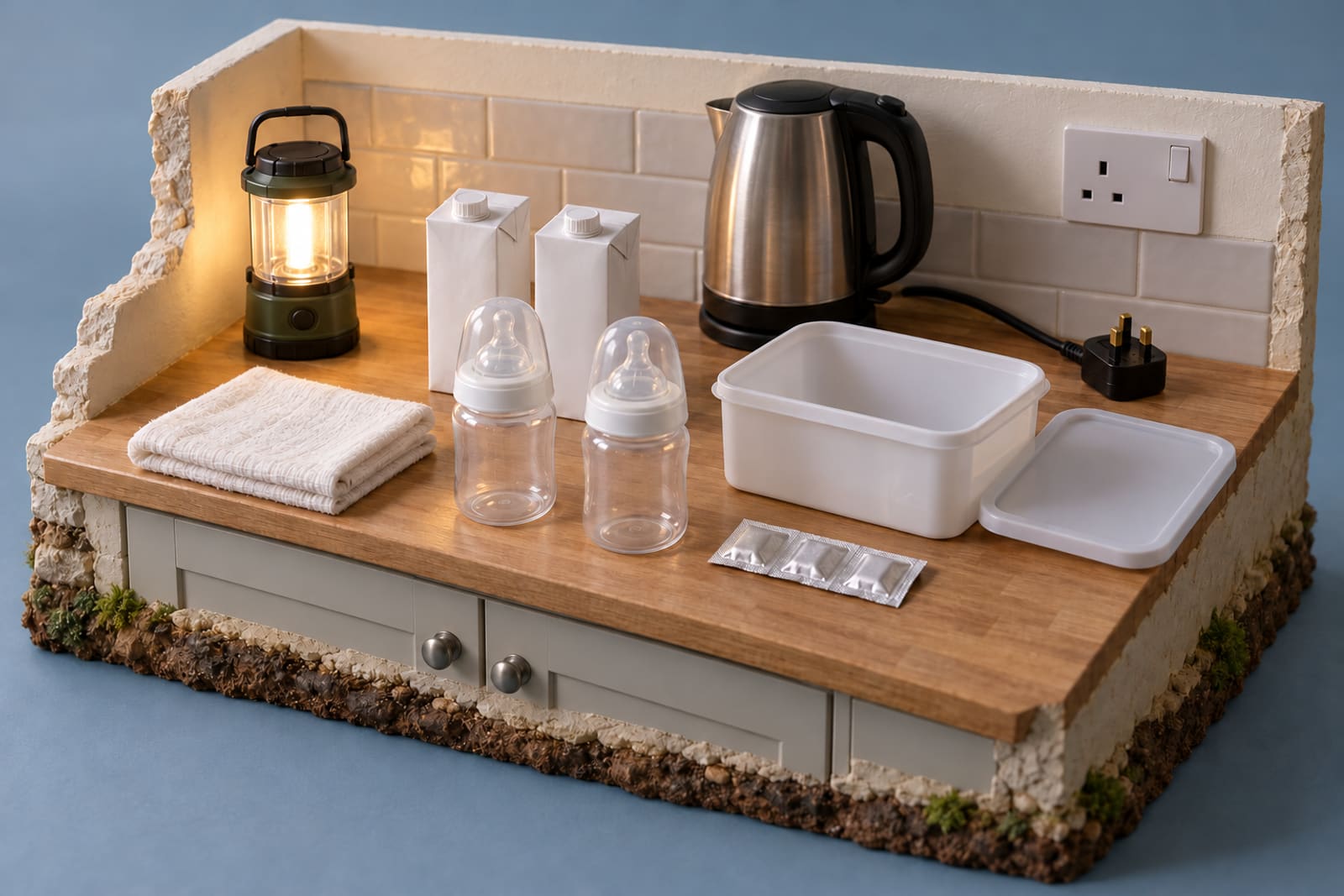
A kitchen worktop with two plain cartons of ready-to-feed formula, two clean baby bottles with teats and caps, a white sterilising tub with its lid off, a strip of sterilising tablets, a folded muslin and a lit battery lantern, with the kettle unplugged behind
Feeds without the kettle: ready-to-feed cartons, clean bottles, a cold-water sterilising tub and tablets, and a lantern to see by.

Sterilise with cold water

Today

Cold-water sterilising works without power. Follow the product's directions, keep everything under the solution with no air bubbles, and leave it at least 30 minutes. Change the solution every 24 hours.

Gas hob working?

You can boil the bottles in a large pan instead, for at least 10 minutes.

Bottled water

It isn't sterile and can be high in sodium or sulphate, so use it for formula only when tap water is unavailable or unsafe. Make the feed up the usual way.

Keep one room warm, and the baby safe in it

Tonight

Keep a baby's room at about 16–20°C, and check it with a room thermometer. A baby should never sleep with a hot water bottle or an electric blanket, or next to a radiator, heater or fire.

  • Bring everyone into one room, and close the door.
  • Feel the chest or the back of the neck to check a baby is warm enough.
  • Don't fall asleep on a sofa or in an armchair with your baby.

Join the Priority Services Register

This week

If you are pregnant or have young children, you can join for free. It gives priority support in an emergency and, where possible, notice of planned power cuts. Register once through your electricity network operator, and the details are shared with your gas and water companies.

In a water outage, households on the register can be offered bottled water. In Northern Ireland, ask NIE Networks and your gas supplier about their care registers.

Agree who collects the children

This month

Schools and nurseries can close at short notice in snow, floods or a long power cut. Agree two people who can collect your children, tell the school who they are, and save the school's number in your phone.

Closures

Check your council's website or the school's own page. Many send a text or an app message.

If you're stuck

Ring the school first, then the person you agreed. Don't drive through flood water to get there.

Tell the children the plan

This month

Keep it short and calm, and do it on an ordinary day. Show them where the torches are, which room you'll all go to, and who will pick them up if you can't. Older children can learn to call 999 and say their address.

  • A torch each, kept by the bed.
  • A bag of games and books that need no power.
  • Children's paracetamol or ibuprofen, in date, with the doses for their age.

Three things for a family with small children

A lantern for the whole room, a thermometer for the baby's room, and power for the phone.

  • Lantern

    A battery lantern for the room you stay in

    Lights a whole room without a flame. The safe replacement for candles.

    • LED, battery-powered, and able to stand or hang
    • A dim setting that lasts all evening
    • Takes the same batteries as your torches
  • Thermometer

    A room thermometer for the bedroom

    Tells you which room is coolest to sleep in, and when it is cooler outside than in, so you know when to open the windows.

    • A large display you can read from bed
    • An indoor and outdoor reading, if you can
    • Runs on AAA batteries
  • Power bank

    A 20,000 mAh power bank

    Keeps phones charged for a couple of days, so you can call 105, check the live map and reach family.

    • 20,000 mAh or more, with a USB-C port
    • Shows how much charge is left
    • Top it up every few months so it is full when you need it

Families with young children, on one page

Nine lines, plus space for the people who can help. Fill it in and keep it inside a kitchen cupboard door.

Families · this month

Download PDF

Other households

See every situation guide

Get the monthly brief: one job before each season turns

One email a month: new guides as they're published, and one job to do before the season turns, from lagging the pipes in autumn to checking the torch batteries before the storms.

We'll only use your email to send the Prep Britain newsletter. Unsubscribe any time. How we handle it