







Skip to content
Prep Britain
Checking warnings…

Rural homes: what changes in an emergency

In the countryside, a power line down in a storm can take longer to reach, the water may come from an electric pump, and the road out can close. This page covers the water, heat, phones and food that see you through a longer wait, and the payments a long power cut can earn.

Reviewed 26 Oct 2026 7 min read Free to read

Do these three first · 20 minutes

Store water

If your water comes from a borehole, a well or a private pump, it stops with the power. Fill containers before a storm.

Check the oil or LPG gauge

An empty tank needs a delivery, and deliveries slow down in snow. Order before the gauge nears the bottom.

Find a radio that needs no mains

Battery or wind-up. When the power and the phone signal go, it is how you hear the news.

Power off? Call 105 Free, and it reaches your local network operator. In Northern Ireland, call NIE Networks on 03457 643 643. In an emergency with no signal, still call 999: it connects through another network if one is in range.

Water, heat and news that don't depend on the mains. With those three, a long wait for the power is uncomfortable rather than serious.

What's different in a rural home

The same storm hits town and country. In the country, more of the house depends on the power, and help can take longer to arrive.

What changes in an emergency in a rural home
WhatWhy it mattersWhat to do
Water A private supply on an electric pump stops in a power cutStore water, and plan another supply for longer cuts
Heating Oil and LPG boilers need power to run, and the tank needs deliveriesKeep the tank topped up before winter, and plan one warm room
Phones Digital landlines stop in a power cut, and the mobile signal may be weakAsk the landline provider about a battery back-up, and keep a radio
Roads Snow, floods or fallen trees can close the only roadKeep a week of food in, and winter kit in the car

Our guides, for a rural home

Each guide covers the whole situation. Here is what changes for you in each one.

Six steps, from the water to the car

Steps one to three are for this autumn, before the storms. Four to six cover the phone, the road and the neighbours.

Store water, and plan a second supply

Before winter

If your water comes from a private supply with an electric pump, it can stop with the power. Keeping it safe and working is the owner's job. Store enough drinking water for a few days, and plan where more would come from in a longer cut.

  • Fill containers and the bath before a storm arrives.
  • Bottled water, a neighbour on mains water, or a bowser are the usual back-ups.

How much water to store has the amounts.
Keep the heat going

Before winter

Oil and LPG boilers need electricity, so a power cut stops the heating even with a full tank. Order fuel early in autumn, before the gauge nears the bottom. A wood-burner or an open fire keeps working without power.

Carbon monoxide

Fit an alarm in every room with a stove, a fire or a boiler that burns oil, gas, coal or wood. A battery one keeps working in a power cut.

Generators

Never run a portable generator indoors, in the garage or by an open window. Have an electrician connect one to the house wiring.

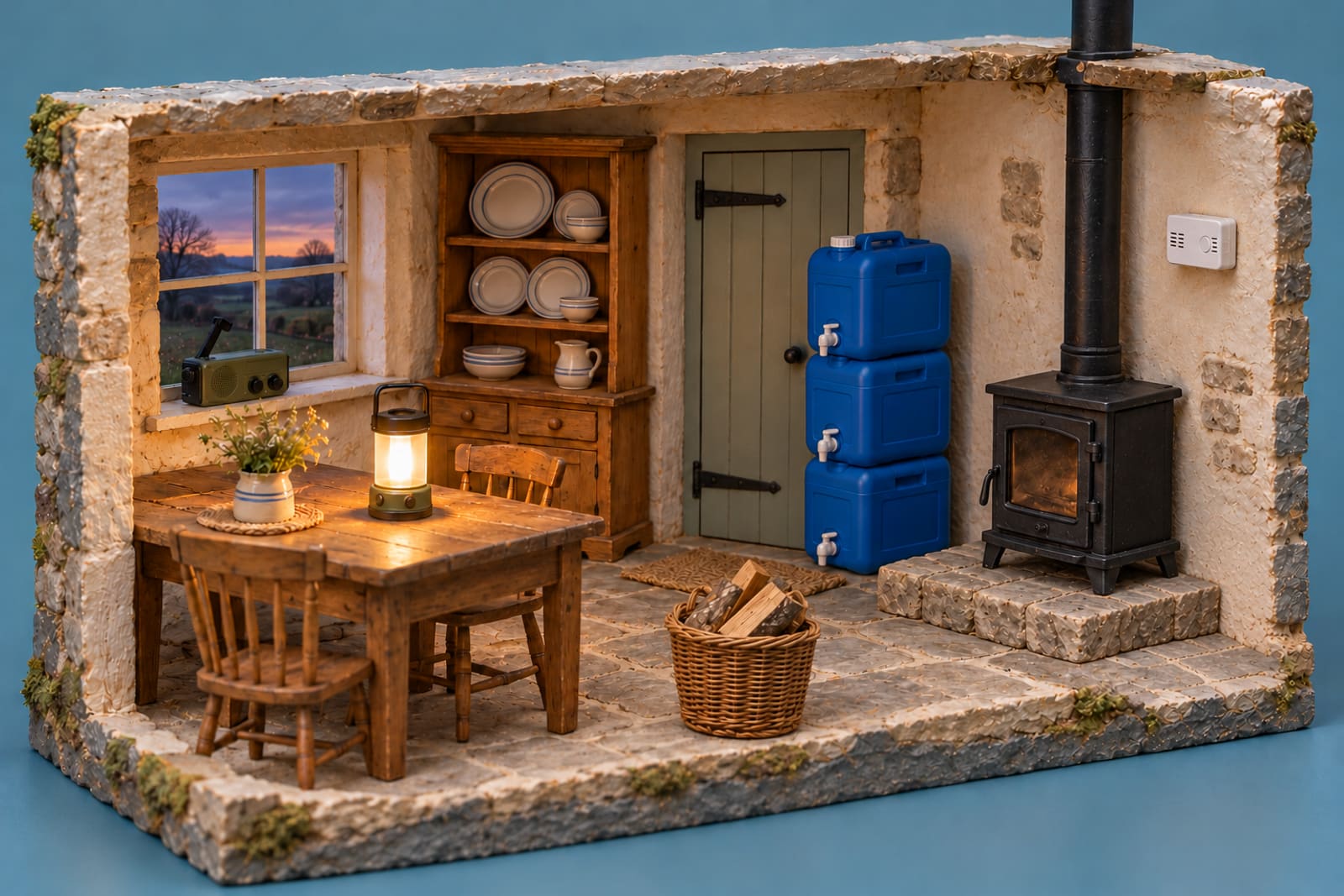
A cottage kitchen cut-away at dusk: three stacked blue water containers with taps by the back door, a wood-burning stove on a stone hearth with a carbon monoxide alarm on the wall beside it, a basket of logs, a radio on the windowsill and a lit battery lantern on the table
Ready for a long cut: stored water by the door, a stove that needs no power with a carbon monoxide alarm beside it, logs, a radio and a lantern.

Keep a week of food in

This month

Snow or a flood can close the road for days. Keep enough food that needs little or no cooking for everyone in the house, including the pets, and a way to heat water that works without power.

A camping stove stays outdoors, every time. Prep cupboard checklist has what to stock.

Sort the phone

This month

Digital landlines need mains electricity and won't work in a power cut without a battery back-up. If you depend on your landline and have no working mobile signal, your provider must offer a free back-up that lasts at least an hour.

No bars?

Still call 999. If another network is in range, the call goes through on that.

News

A battery or wind-up radio gets local news and travel when the phone and the broadband are down.

Get the car ready for winter

Before the first frost

The Highway Code says not to drive in icy or snowy weather unless your journey is essential. If you must, carry the winter kit and keep the tank above a quarter.

  • Ice scraper and de-icer, a torch, a warm coat and boots.
  • A first aid kit, jump leads and a shovel.
  • A flask of hot drink and some food.
  • Never drive into flood water. It's deeper and faster than it looks.

Agree who checks on whom

This month

Houses far apart mean nobody notices a dark window. Swap numbers with two neighbours, agree to check on each other in a long cut or heavy snow, and know who nearby lives alone or uses equipment that needs power.

Anyone who depends on power for medical equipment should join the Priority Services Register.

Payments for a long power cut

In Great Britain, the network operator pays automatically after a long cut. Storms have their own rules.

Payments for long power cuts in Great Britain and Northern Ireland
CutPaymentHow
Over 12 hours, fewer than 5,000 homes off £100Paid automatically. Then £45 for each further 12 hours
Over 24 hours, 5,000 or more homes off £100Paid automatically. Then £45 for each further 12 hours, up to £400
Storm, category 1 £90After 24 hours. Then £45 for every further 6 hours
Storm, category 2 £90After 48 hours. Then £45 for every further 6 hours. Storm payments are capped at £2,235
More than 4 cuts between April and March +£100You claim this one. Each cut must have lasted at least 3 hours
Northern Ireland, over 24 hours £50Then £25 for each further 12 hours. Claim from NIE Networks within one month

Three things for a rural home

Water you can carry, news without the mains, and an alarm for the stove.

  • Water container

    A 10-litre water container with a tap

    For water you collect from a bowser in a long outage. It stands on the worktop and pours without lifting. For storing water ahead of time, buy sealed bottles instead.

    • Food-grade plastic, marked BPA-free
    • A screw-on tap, so it can stand on a worktop
    • 10 litres or less, so it can be carried full
  • Radio

    A wind-up or battery radio

    Local radio carries updates when the mobile network is busy or down.

    • Wind-up or solar charging, as well as batteries
    • FM and DAB
    • A built-in torch is a useful extra
  • Carbon monoxide alarm

    A battery carbon monoxide alarm

    Carbon monoxide has no smell. A battery alarm keeps working in a power cut, when you are most likely to use a heater or stove.

    • Meets EN 50291
    • A sealed battery that lasts the life of the alarm
    • One for each room with a gas, oil, coal or wood appliance

Rural homes, on one page

Nine lines, plus space for your suppliers and neighbours. Work through it in autumn, before the storms.

Rural homes · before winter

Download PDF

Other households

See every situation guide

Get the monthly brief: one job before each season turns

One email a month: new guides as they're published, and one job to do before the season turns, from lagging the pipes in autumn to checking the torch batteries before the storms.

We'll only use your email to send the Prep Britain newsletter. Unsubscribe any time. How we handle it