



Skip to content
Prep Britain
Checking warnings…

No water from the tap? Find the fault, then make every litre count.

When the taps cough and stop, it's usually one of three things: the main in the street, the pipes in your own home, or the cold. Five minutes of checks tells you which, and who fixes it. The rest of this page makes the water you've got go as far as it needs to: drinking first, then cooking, washing and the toilet.

Reviewed 3 Oct 2026 14 min read Free to read

Do these three first · 2 minutes

Try the cold kitchen tap

It comes straight off the mains. If it runs and the others don't, the problem is inside your home.

Ask a neighbour

Dry next door too? It's the network, and the water company is on it. Only you? Keep reading.

Turn every tap off

An open tap you forgot about floods the sink when the water comes back, often at 3am.

Check your water company first There's no single number like 105 for water. Your company's 24-hour line is on your bill, and its website has a live map of problems by postcode. Not sure who supplies you? CCW lists every water company.
Scotland: Scottish Water on 0800 0778 778. Northern Ireland: NI Water on 03457 440088. Both lines are open 24 hours.

If the whole street is dry, the main in the road is the water company's job. If it's just your house, it's usually yours.

Work out where the water stopped

Water reaches your taps through the main in the street, a pipe across your front garden, a stopcock, and often a tank in the loft. Three checks tell you which link is broken.

Is it just your home?

Try the cold kitchen tap first: it's usually where the supply comes in. Then knock next door. If they're dry too, the problem is probably on the water company's network.

Is the stopcock open?

Builders, plumbers and previous owners leave them half shut. Turn it anticlockwise as far as it will go. Stiff is normal; don't force it with a wrench.

Has it been below freezing?

A pipe in the loft, the garage or on an outside wall may have frozen. Turn the stopcock off in case it's split, then thaw it slowly. The steps are below.

Match what you're seeing

Common signs of a water supply problem, what they usually mean, and what to do
What you noticeProbablyDo this
Every tap dry, neighbours too The mainCheck your company's live map and save what water you have. Report it if it isn't listed.
Every tap dry, neighbours fine Your pipesCheck the stopcock is fully open, and the outside stop tap if you can reach it. Some homes share a supply pipe with next door. In cold weather, look for a frozen pipe. Then call a plumber, or your landlord.
Kitchen cold tap runs, the rest are dry Your plumbingOften the cold tank in the loft has emptied or its float valve has stuck. Either way the fault is inside your home, so call a plumber.
Only a trickle PressureOften busy times or works nearby. If it lasts more than a day, or only you are affected, tell your water company.
Upper-floor flat, dry, and the power is off The pumpMany blocks pump water up to higher floors. It comes back with the electricity.
Hissing, dripping, a wet ceiling A burstTurn the stopcock off now, and the boiler. If water has reached the electrics, don't touch them: switch off at the fuse box.

Need a plumber? NI Water points to WaterSafe's list of approved plumbers. The rough rule on who fixes what: the water company looks after the main in the road and the pipe up to your boundary, usually where the outside stop tap sits. From there to your taps is normally yours, or your landlord's.

Find your stopcock tonight rather than during a burst

It's the tap that turns off all the water to your home. Finding it takes two minutes on a calm evening and ten panicked ones with water coming through the ceiling.

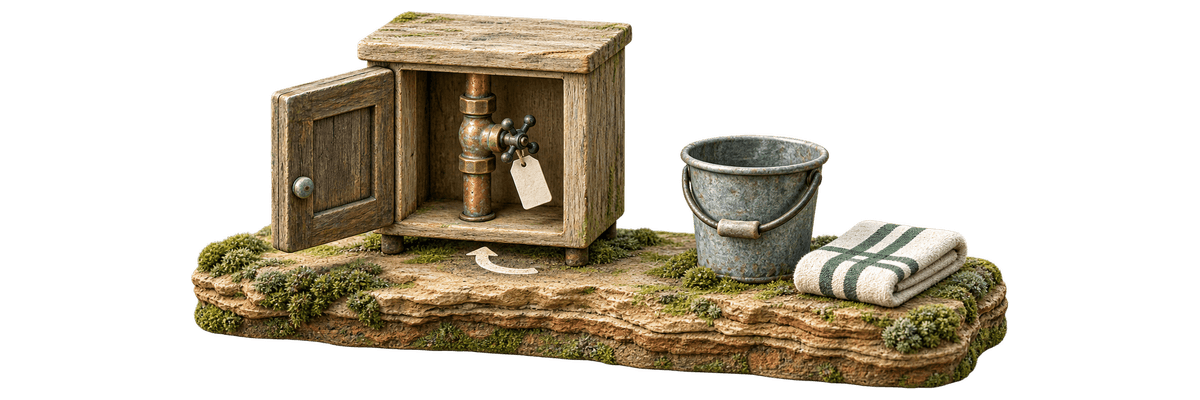
An open kitchen cabinet with the stopcock on the water pipe inside, a tag tied to its handle and an arrow pointing to it, with a bucket and a folded towel beside it
Most stopcocks are under the kitchen sink. Tie a tag on yours so anyone can find it.

Where to look

  • Under the kitchen sink, where the pipe comes up through the floor.
  • In the airing cupboard, or under the floorboards by the front door.
  • Under the stairs or in a downstairs loo.
  • In a flat: a hallway cupboard, or ask the landlord or managing agent.

How to use it

  • Clockwise closes it, anticlockwise opens it. Righty-tighty.
  • Open it fully, then back a quarter turn so it doesn't seize.
  • Check it still turns every six months, as the Met Office advises.
  • Won't budge? Don't force it. A plumber can fit a new one for far less than a flood costs.
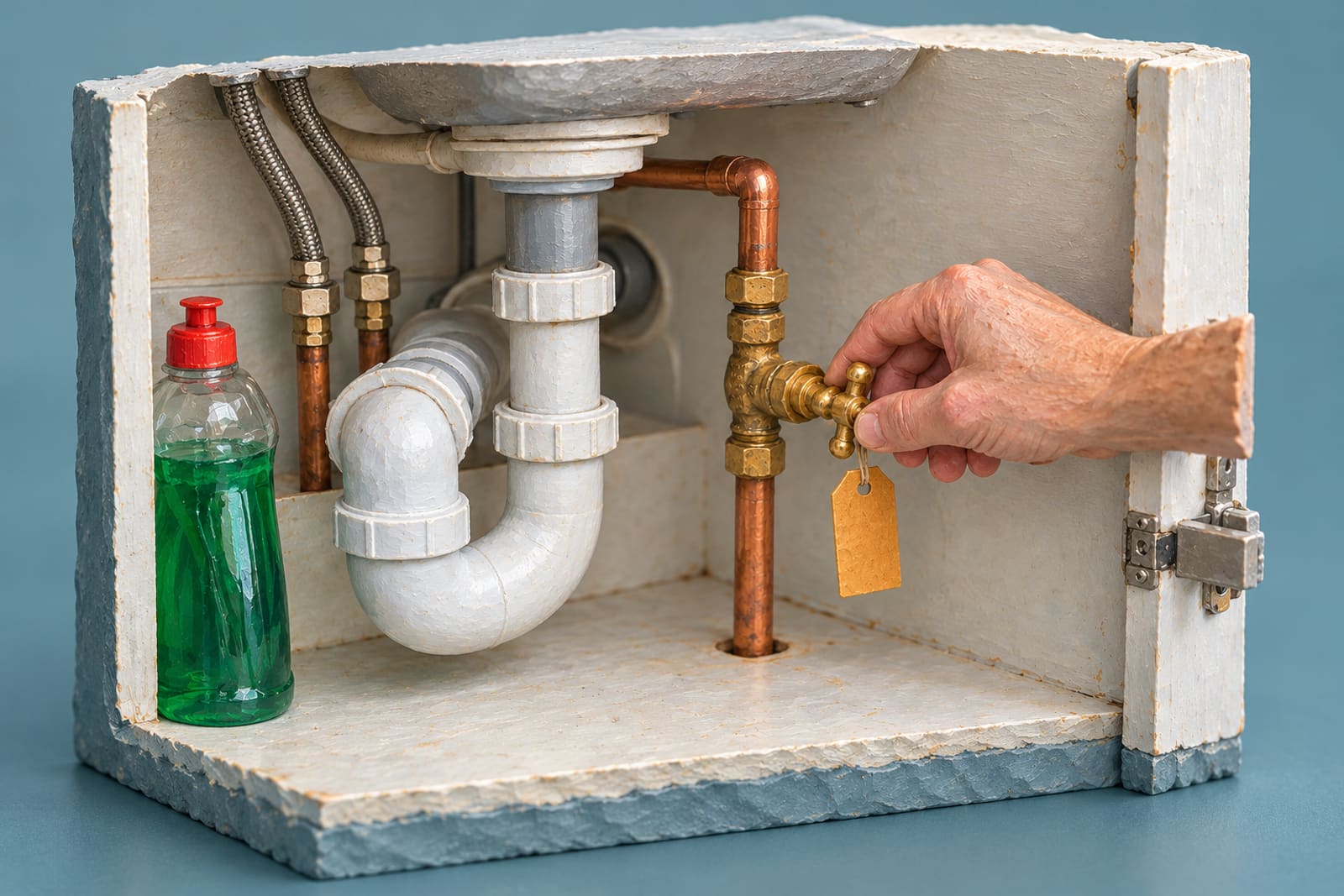
A hand turning the crosshead handle of a brass stopcock on the copper pipe rising through the floor of a kitchen sink cupboard, with an orange tag tied to the handle
What you're looking for: a brass tap on the pipe that comes up through the floor. Clockwise closes it.

Thaw it slowly. Stop a burst fast.

A frozen pipe inside your home is yours to sort rather than the water company's.

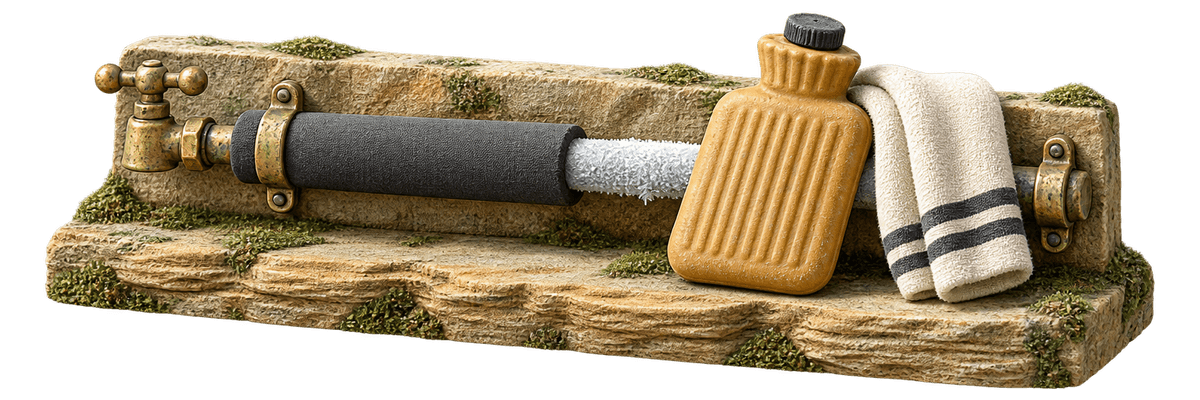
A pipe on a wall, half wrapped in foam lagging, with a hot water bottle and a folded towel warming the bare section
Gentle heat on the frozen section, with the stop tap off. Lagging stops it happening again.

If a pipe has frozen

  • Turn the stop tap off, in case the pipe has split.
  • Turn on the nearest cold tap to relieve the pressure.
  • Thaw it slowly, with hot water bottles or towels soaked in hot water.
  • Never use a naked flame or a blowtorch. Direct heat can damage the pipe for good.

If a pipe has burst

  • Turn off the stop tap and switch off the boiler.
  • Open every tap to drain the system fast. Catch some in a bucket for flushing the toilet.
  • Soak up the water with towels to limit the damage.
  • Water near the electrics? Don't touch them. Switch off at the fuse box.

Frozen and burst pipes: your questions

My boiler has stopped in freezing weather. Is it a frozen pipe?

On a condensing gas boiler, it's likely to be the condensate pipe: usually a white plastic pipe that comes out below the boiler and runs outside. Pour lukewarm water over it to thaw it, never boiling water, which can crack the pipe. Mind the ground afterwards, where the water can freeze.

Can I use a hairdryer to thaw a frozen pipe?

Yes. A hairdryer, a fan heater or a hot water bottle will thaw it. Turn the stop tap off first and open the nearest cold tap, then go slowly. Never use a naked flame or a blowtorch: direct heat can damage the pipe for good, or start a fire. Keep the hairdryer and its lead away from any dripping water.

Who fixes a burst pipe: me or the water company?

It depends where it is. The water company looks after the main and the pipe that joins it to yours, under the road. From the edge of the road, the supply pipe to your home belongs to the owner, even where it crosses someone else's land, and a supply pipe shared by several homes belongs to all of them. The plumbing inside your home is yours too.

Call a WaterSafe approved plumber, and check whether your buildings insurance covers the damage. Renting? Tell your landlord straight away.

Should I leave the heating on to stop the pipes freezing?

If you're going away in cold weather, yes: leave it on low. And make sure the pipes in the loft or roof space are lagged.

Six steps that make your water last

Most water cuts are fixed within a few hours, and steps one to three cover them. Four to six are for when the evening turns into a night, or the night into a few days.

Keep what's still in the pipes

0–10 min

When the supply stops, there's usually a little left: in the pipes, the kettle, the loft tank and the toilet cistern. It won't last long, so decide what it's for before it goes on a second cup of tea.

  • If a trickle is still coming through, fill the kettle and a couple of jugs for drinking.
  • Turn every tap off and take the plugs out, so nothing overflows when the water returns.
  • The cistern holds one flush. Save it rather than using it straight away.
Find out how long it'll be

10–30 min

Put your postcode into your water company's website. It'll say whether they know, what's wrong, and when the water should be back. No website? Ring the number on your bill. Write the estimate down where everyone can see it.

Under 12 hours

Nothing clever. Drink from what you've saved, skip the washing-up, wait. In an emergency, your water company must restore the supply within 12 hours of finding out.

Over 12 hours

Work through steps three to five. The company may set up bottled water stations or bowsers. Its website says where.

Planned work that cuts the water for more than four hours needs written notice: 48 hours in England, 24 in Wales. If you got the letter, the water should be back by the time it gives.

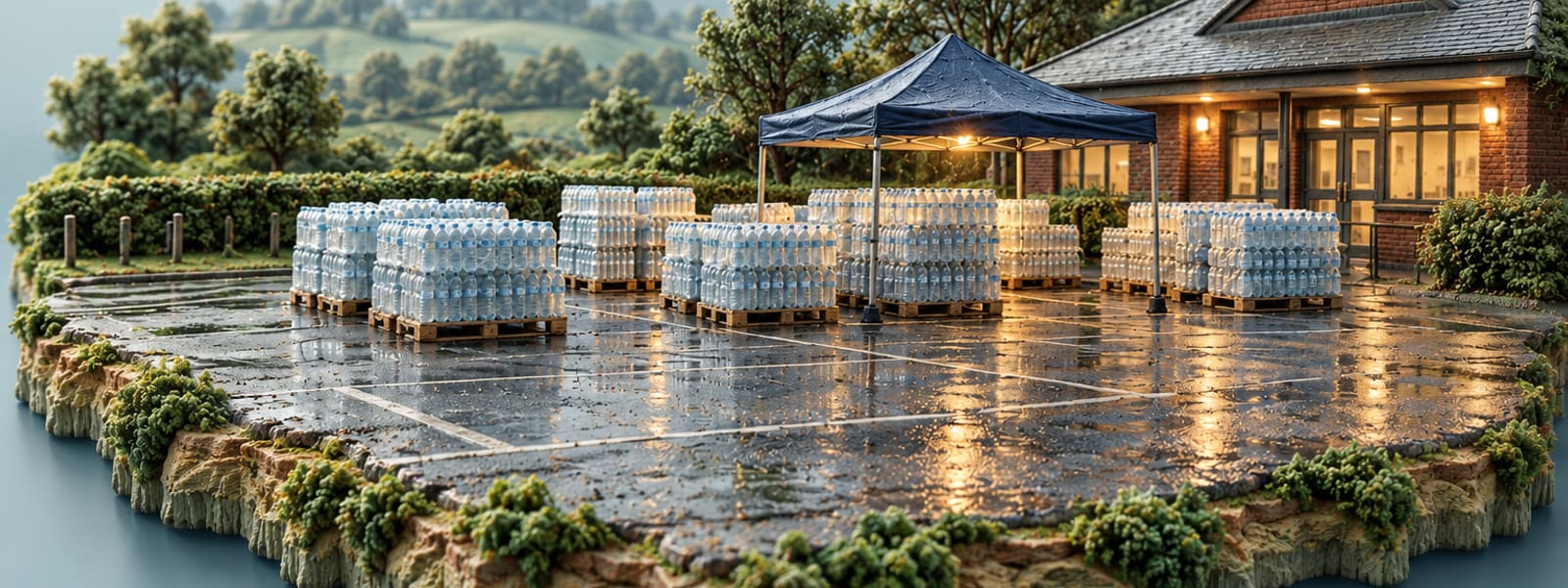
A bottled water station in a car park beside a community hall at dusk in the rain: pallets of shrink-wrapped bottled water under and around a gazebo, lights on in the hall
In a long outage, look for a bottled water station or a bowser. Take a trolley or a strong bag: water is heavy.

Drinking water comes first

First hour

The minimum is 2.5 to 3 litres a person a day to drink. Ten litres a day covers cooking and washing too. Keep drinking water for drinking, medicines, baby feeds and pets first, cooking second. Everything else can come from somewhere less precious.

Roughly how much water everyday jobs use when the taps are off
JobRoughlyMake it go further
Drinking, per adult 2–3 litresSip through the day. Squash, juice and fizzy drinks from the cupboard count.
Cooking and teeth 1 litrePasta in less water, a cup for rinsing.
A strip wash 2–3 litresA bowl and a flannel, top to toe.
One toilet flush 6–9 litresA bucket poured into the bowl. Not every time.

Making up baby formula? If you can't boil water, use ready-to-feed formula. Bottled water isn't usually recommended, because it isn't sterile and can carry too much salt or sulphate, but the NHS allows it when tap water is unavailable. Boil it first, as you would tap water.

Keep clean and keep the toilet working

The first evening

Clean hands matter more than ever when there's no running water. For the toilet, pour a bucket of water straight into the bowl, briskly, and it flushes. Filling the cistern works too but takes more.

  • Hand sanitiser for after the toilet and before food. Wipes for everything else.
  • No sanitiser? Fill a washing-up bowl with water and add soap or household disinfectant. Everyone uses the same bowl.
  • Rain from a water butt, a paddling pool or a bath you filled earlier is fine for flushing.
  • Paper plates and one-pan meals mean no washing-up.

Not for drinking. Water from the loft tank, the hot water cylinder, radiators, water butts or the toilet cistern. Boiling kills germs but doesn't take out chemicals or rust.

Check on the people nearby

As soon as it's safe

A six-pack of two-litre bottles weighs 12 kilograms. That's nothing for some people and impossible for others. Knock on two doors, and offer to bring water back for anyone who can't carry it.

Priority Services Register

Your water company keeps one, free to join. There's no automatic right to bottled water, but if a health condition makes collecting it hard, the company will bring it to you. In Northern Ireland it's NI Water's Customer Care Register.

Medical needs

Kidney dialysis at home, or other equipment that needs water? Tell the water company now, and plan with your care team.

Run it clear, then check what you're owed

When it's back

Taps will cough and spit for a minute as the air comes out. Start with the cold tap nearest your stopcock, usually the kitchen one, and let it run to see if it clears before you drink from it.

Cloudy or white

Tiny air bubbles, and not harmful. Fill a glass and watch: if it clears from the bottom up, it's air. It should be gone within 24 hours.

Brown, orange or black

Harmless deposits stirred up in the pipes. Run the cold tap and see if it clears. If it doesn't, don't drink it until your water company says it's safe.

  • Hold off on the washing machine until the water runs clear.
  • Still cloudy after 24 hours, or a strange taste or smell? Call your water company.
  • A combi boiler may show a fault after the water was off. Reset it as the manual says.
  • Write down the one thing you wished you'd had. Buy it this month.
Fixed payments when the water company misses its standards for a supply interruption, in England and in Wales
What happenedEnglandWales
Not back within 12 hours of an emergency, or by the time a notice gave £50£20
Each further period without water £50 per 12 hours£10 per 24 hours
Planned work without the written notice £50£20, if you claim

Set by the Guaranteed Standards Scheme. Payments are automatic apart from the one marked, and in England they're capped at twice your yearly water supply charge. Scottish Water and NI Water have their own standards.

Three notices, three different rules

Now and then the water keeps running but you're told not to trust it. The wording matters: each notice allows different things.

Boil water

Boil tap water and let it cool before drinking it, brushing teeth, making ice, preparing food, cleaning feeding equipment or giving it to pets. Keep cooled water in the fridge and use it within 24 hours. Showers, laundry and flushing are fine.

Do not drink

Boiling won't make it safe. Use bottled water for drinking and cooking. Still fine for washing and flushing.

Do not use

Rare. Stop using the tap water and use bottled water, or the supply your water company provides. The notice says whether you can still flush.

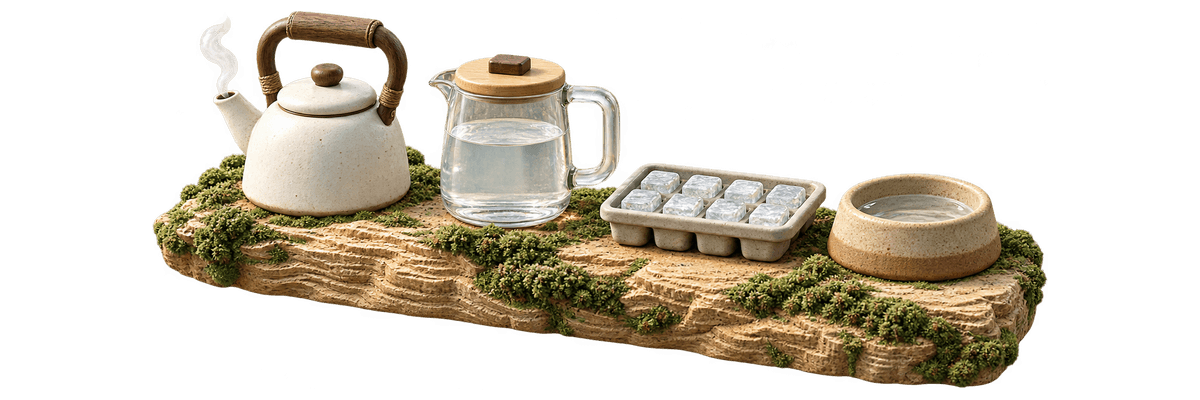
A kettle, a lidded jug of cooled water, an ice cube tray and a pet's water bowl in a row
Under a boil water notice: the kettle first for drinking, ice, food and the pets' bowl.

Notices come by letter, text, or on your water company's website. Follow them until you're told they've been lifted, even if the water looks fine.

Boil water notices: your questions

How long should I boil water for under a boil water notice?

Bring it to a rolling boil, then take it off the heat and let it cool on its own. Keep it in a clean container in the fridge, and throw away anything you haven't used within 24 hours. Take care with scalds.

Can I shower or have a bath under a boil water notice?

Yes. Keep the water out of your mouth.

Can I wash up or do the laundry?

Yes. Wash up in hot water and dry everything thoroughly before you use it. Laundry and flushing the toilet carry on as normal.

Can I make up baby formula under a boil water notice?

Yes, the usual way. The NHS method already boils fresh tap water, and uses it while it's still at least 70°C. Can't boil water at all? See the note on ready-to-feed formula in the six steps.

What should I do when a boil water notice is lifted?

If you have a cold water tank, or you were away while the notice was on, run all the cold taps on full for 30 minutes. Fit new filters in filter jugs and plumbed-in filters. Throw away old ice and make fresh.

How much water should you keep?

Buy sealed bottled water rather than filling your own containers, which is GOV.UK Prepare's advice. Say who's at home, what the water is for and how long to plan for, and see what that looks like in bottles. Our guide to how much water to store covers storing and rotating it in more depth.

1 Who's in the house?
  • AdultsIncludes anyone over 16.2
  • ChildrenCount them as adults. It covers the cooking done for them.0
  • DogsAbout a litre for a medium dog. More for a big one or in hot weather.0
  • Cats and small petsA quarter of a litre each.0
2 What's it for?
3 For how long?

Keep about

18 litres

6 litres a day for 3 days. It weighs about 18 kg, so keep it low down and near where you'll use it.

  • Adults: 18 L

That's 9 two-litre bottles, or 2 six-packs from the supermarket. Sealed bottles keep until the date on the label.

Allow more in hot weather, and for anyone ill, pregnant or breastfeeding. Flushing is extra: one flush poured from a bucket takes 6 to 9 litres.

Check the date on each pack, and use the oldest first.

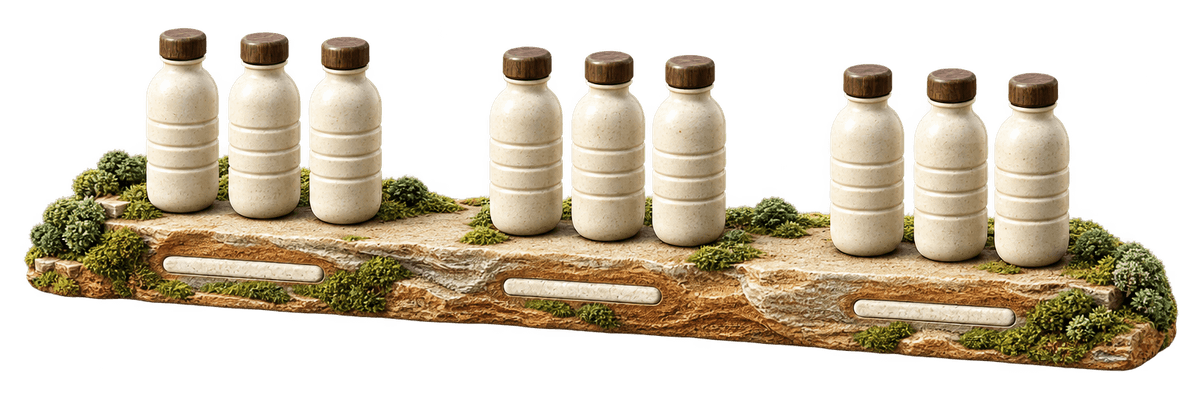
Nine one-litre water bottles in three groups of three
One person, three days of drinking water: nine litres. How much water to store, and how to keep it.

Three things worth having in the cupboard

Sealed supermarket bottles are the store itself. These cover the rest: water you collect from a bowser, and a winter without frozen pipes.

  • Water container

    A 10-litre water container with a tap

    For water you collect from a bowser in a long outage. It stands on the worktop and pours without lifting. For storing water ahead of time, buy sealed bottles instead.

    • Food-grade plastic, marked BPA-free
    • A screw-on tap, so it can stand on a worktop
    • 10 litres or less, so it can be carried full
  • Water carrier

    A pair of collapsible water carriers

    For fetching water from a bowser, or from a friend's tap across town. Folds flat in a drawer the rest of the time.

    • 10 litres or less each, so they can be carried full
    • A proper handle and a spout
    • Food-grade and easy to rinse out
  • Pipe lagging

    Foam lagging for exposed pipes

    A frozen pipe is one of the commonest reasons for a single house to lose water in winter. Lagging the pipes in the loft, garage and outside walls is an afternoon's job.

    • Sized to your pipe: 15 mm or 22 mm for most homes
    • At least 13 mm thick
    • Tape for the joins and bends

The first hour, on one page

Nine lines, in order. Print it once and tape it inside the cupboard under the sink, next to the stopcock.

No water · first hour

Download PDF

If it's something else

See every situation guide

Get the monthly brief: one job before each season turns

One email a month: new guides as they're published, and one job to do before the season turns, from lagging the pipes in autumn to checking the torch batteries before the storms.

We'll only use your email to send the Prep Britain newsletter. Unsubscribe any time. How we handle it