Skip to content
Prep Britain
Checking warnings…

Be Ready: the government's three-day advice

On 22 October the government asked every household in the UK to be ready to look after itself for three days. The Prime Minister, Andy Burnham, backed it the next day. This page sets out what the checklist asks for, how much it comes to for your home, and how to build it up over a month of ordinary shopping.

Reviewed 24 Oct 2026 8 min read Free to read

Make a start this weekend · 20 minutes

Check your cupboards first

Count meals that need no cooking: three days is nine a person. Most homes are further along than they think.

Write the numbers on paper

105 for a power cut in Great Britain, 03457 643643 in Northern Ireland, your GP, and the people you would call.

Add water to the next shop

One six-pack of 2-litre bottles a person covers the drinking water. That is the item most homes are missing.

Three days of water, food that needs no cooking, a torch, a radio and some cash. Most of it is already in your kitchen, and the rest fits into a month of normal shopping.

What the government announced this week

The Cabinet Office launched Be Ready on Wednesday 22 October, with a written statement to Parliament from the Security Minister, Dan Jarvis. It asks households to be able to manage for three days if the power, water, phones or internet go off, "while support reaches those in need". It is the first stage of a three-year campaign, and more than 500 charities and businesses have signed up to share it.

For the first time, the government has put a number on it. The older GOV.UK Prepare advice spoke of "an emergency lasting a few days" and gave no amounts. Be Ready says three days, and 3 litres of drinking water a person a day. That brings the UK into line with France, Ireland and the Netherlands, which already use a three-day message.

Jarvis put the reasons plainly: "The storms last winter and the wildfires this summer have shown how severe weather events can cause disruption." Ministers have also pointed to cyber attacks. This week, government websites were briefly taken offline as a precaution after a security flaw was found in widely used web software.

On Friday, as storms cut power to homes in Cornwall, Andy Burnham backed the advice at a wildfire resilience summit in Liverpool. "Unexpected events seem to be becoming more and more common," he said. On BBC Radio 5 Live he added: "It's not about panicking. It's about just taking sensible measures to have enough in the house to tide you over." His own cupboard, he said, holds beans, soup and Twiglets.

The campaign was planned under Keir Starmer. Bloomberg reported that Burnham held back the launch, worried it would look too gloomy at the start of his premiership. The Conservative leader, Kemi Badenoch, said the government should do more to "look after us" than hand out advice. Burnham rejected the idea that households were being asked to step in because the government had failed to prepare.


The coverage, in order

  1. · National Audit Office

    Resilience of the food supply chain to disruptions (opens in a new tab)

    Finds that planning for food shocks from storms, cyber attacks and disease "has not kept pace" with the risks, and that the government needs to do more with households.

  2. · LADbible

    Defence Secretary warns Brits to stock up on three items in case of an emergency (opens in a new tab)

    Wes Streeting asks households to keep some cash, bottled water and tinned food at home.

  3. · Cabinet Office

    Households encouraged to take small, simple steps to stay prepared in an emergency (opens in a new tab)

    The Be Ready campaign launches, with a written statement to Parliament from the Security Minister, Dan Jarvis. It is the first stage of a three-year campaign.

  4. · The National

    UK government advises stockpiling water and food (opens in a new tab)

    The British Retail Consortium warns that "panic buying is quite easy to generate", and points back to the empty shelves of March 2020.

  5. · Anadolu Agency

    British premier urges UK households to stockpile water, food amid rising risks (opens in a new tab)

    Andy Burnham backs the advice at a wildfire resilience summit in Liverpool, as storms cut power in Cornwall.

What the Be Ready checklist asks you to keep

Nine groups of things, most of which you can find at a supermarket. The middle column is what the checklist says. The last is what we'd do.

The Be Ready checklist: each group, what the government's checklist says, and our practical note
GroupWhat the checklist saysWhat we would do
Water Bottled water for 3 days: 3 litres a person a day to drink. More for cooking and washing.For one person that is 9 litres, about five 2-litre bottles. The table below works it out for your household.
Food Non-perishable food for 3 days that needs no fridge and no cooking, such as tinned meat, fish or vegetables, dried fruit and nuts.Count meals rather than tins: nine a person, plus snacks. Buy what you already eat, and keep a manual tin opener with it.
Hygiene Hand sanitiser, wet wipes, and hygiene and bathroom products.Bin bags too. If the water is off, the toilet needs a plan.
Light and warmth A torch and spare batteries. Blankets, sleeping bags and warm clothing.One torch per person, kept where you can find it in the dark. Torches are safer than candles.
Radio and power A battery or wind-up FM radio. A charged power bank.Find your local BBC station on the radio now and write the frequency on the back.
Money and documents Cash in coins and notes, and cards. Copies of ID and documents. Important phone numbers, your regular medicines and doses.Small notes and coins. Put the paper list and the copies in one clear wallet.
Medical A first aid kit or first aid items. Essential medicines and medical supplies.Order repeat prescriptions up to five working days before you run out, so there is always a few days in hand.
Babies Ready-to-feed formula, as you may not be able to boil water for powder. Nappies and wipes.Only if you need them. Check the dates on the cartons.
Pets Pet food and bottled water.Count the pet in when you work out the water.
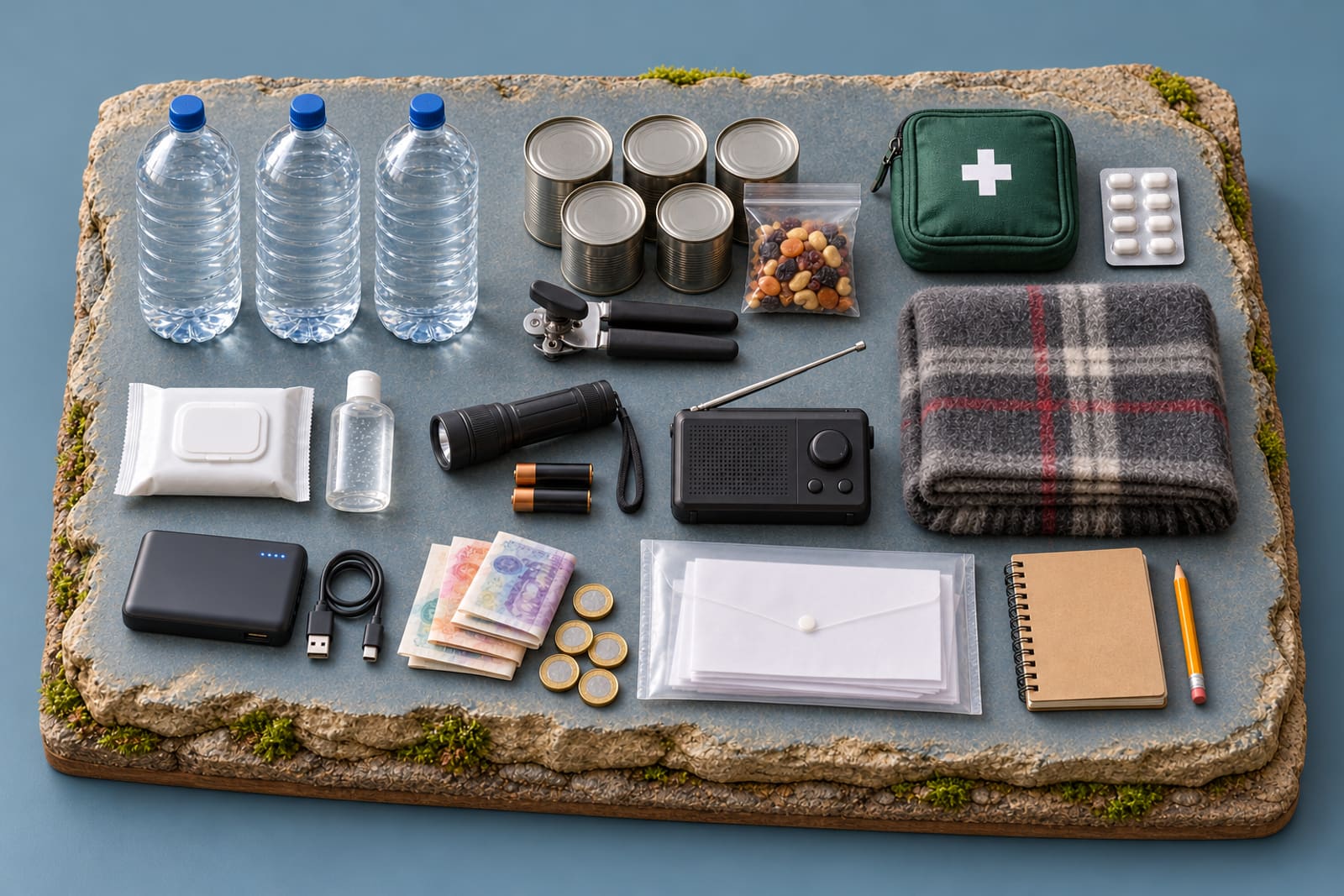
An emergency kit laid out on a stone board: three 2-litre bottles of water, five tins, a bag of fruit and nuts, a tin opener, wet wipes, hand sanitiser, a torch and AA batteries, a battery radio, a folded wool blanket, a power bank and cable, banknotes and pound coins, a clear document wallet, a notebook and pencil, a green first aid pouch and a blister pack of tablets
The whole checklist fits on one shelf. Water and tins take most of the room; the torch, radio, power bank, cash and papers fit in a shoebox.

Scotland and Northern Ireland have their own versions on Ready Scotland (opens in a new tab) and nidirect (opens in a new tab), with the same three days. The full checklist is a two-page PDF on GOV.UK Be Ready (opens in a new tab), and our Prep cupboard checklist lets you tick it off as you go.

How much water your household needs for three days

At the checklist's 3 litres a person a day, to drink. Bottles are 2 litres; six-packs hold 12.

Drinking water for three days by household size, in litres, 2-litre bottles and six-packs
HouseholdTo drink (3 days)In 2-litre bottlesIn six-packs
1 person 9 litres5 bottles1 six-pack
2 people 18 litres9 bottles2 six-packs
3 people 27 litres14 bottles3 six-packs
4 people 36 litres18 bottles3 six-packs
5 people 45 litres23 bottles4 six-packs

That covers drinking only. Cooking and washing need more, and the checklist says so. If you have room, the comfortable figure is 10 litres a person a day. How much water to store has a calculator, and shows how to keep it fresh.

Get ready over four ordinary shops

The checklist says to add things gradually during your regular shopping, to spread the cost. That also keeps the shelves full for everyone.

  1. Shop 1

    Water

    One six-pack of 2-litre bottles for each person, or as many as fit in the boot. Put them somewhere cool and dark.

  2. Shop 2

    Food

    A few extra tins and packets of what you already eat: beans, soup, tinned fish, crackers, dried fruit and nuts. Add a tin opener if yours is electric.

  3. Shop 3

    Light, radio and power

    A torch and batteries, a battery or wind-up radio, and a power bank. These are the dearest items, and they last for years.

  4. Shop 4

    Health and cash

    A first aid kit, wet wipes and sanitiser, and some cash in small notes and coins. Order any repeat prescription early.

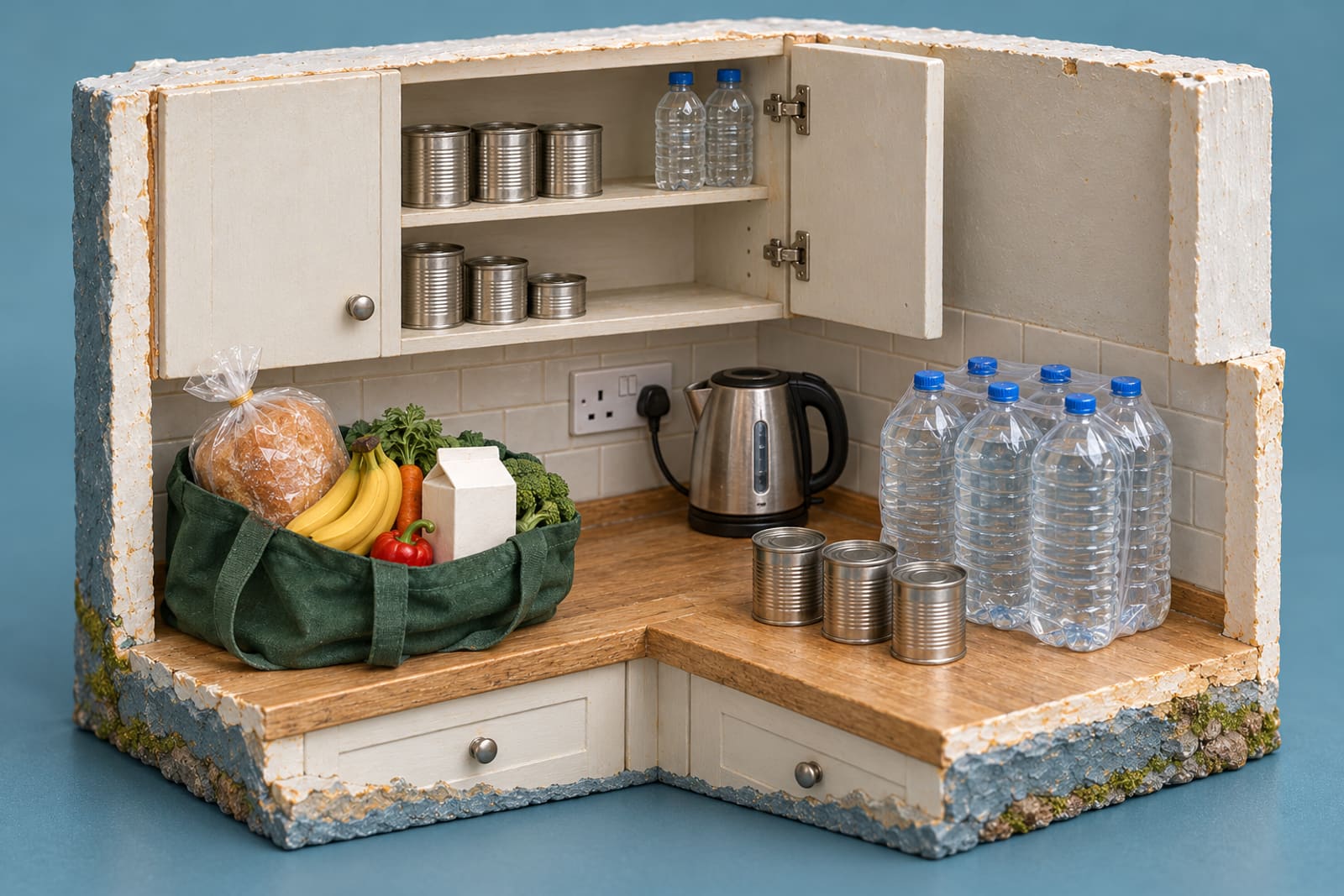
A kitchen corner with a bag of shopping on the worktop, a six-pack of 2-litre bottled water and three tins set beside the kettle, and a wall cupboard above that is half full of tins and water
A normal weekly shop, plus a six-pack of water and a few tins for the cupboard. Do that four times and you're done.

Why slowly matters. Shops restock every day, but not for a whole town buying water at once. In March 2020 the shelves emptied in days, and the British Retail Consortium has warned it could happen again. Buying a little each week gets you to three days without leaving anyone else short. Once it's done, check the dates every six months and eat the oldest first.

The steps that cost nothing

Half of Be Ready isn't shopping at all. These come from the same campaign, and each takes a few minutes.

  • Join the Priority Services Register

    Free, through your energy and water companies. It covers anyone who relies on power for medical equipment, older people, and households with children under five. In Northern Ireland it's called the Customer Care Register. Check you're eligible (opens in a new tab).

  • Write the important numbers on paper

    105 for a power cut, your GP, your insurer, and the people you'd call. Add your medicines and doses, and the frequency of your local radio station.

  • Swap numbers with your neighbours

    Find out who nearby lives alone or would struggle if the power went off, and agree to knock on their door if it does.

  • Learn where to turn things off

    The stopcock, the gas valve and the fuse box. Find them in daylight, and check the stopcock still turns.

  • Sign up for weather and flood warnings

    Met Office warnings by email, and flood warnings by phone or text in England. Our warnings page shows what's in force now.

Three things from the checklist worth buying once

Water and tins come and go. These last for years, and they're the items most homes don't already have.

  • Radio

    A wind-up or battery radio

    Local radio carries updates when the mobile network is busy or down.

    • Wind-up or solar charging, as well as batteries
    • FM and DAB
    • A built-in torch is a useful extra
  • Head torch

    A head torch for each adult

    Leaves both hands free for stairs, the consumer unit and the kettle. One per person beats one lamp per house.

    • Runs on AA or AAA batteries, so it works when USB chargers are flat
    • A red-light mode that keeps night vision
    • At least 200 lumens
  • Power bank

    A 20,000 mAh power bank

    Keeps phones charged for a couple of days, so you can call 105, check the live map and reach family.

    • 20,000 mAh or more, with a USB-C port
    • Shows how much charge is left
    • Top it up every few months so it is full when you need it

If it's something else

See every situation guide

Get the monthly brief: one job before each season turns

One email a month: new guides as they're published, and one job to do before the season turns, from lagging the pipes in autumn to checking the torch batteries before the storms.

We'll only use your email to send the Prep Britain newsletter. Unsubscribe any time. How we handle it